Intersection AEB Tests Find Strong Left-Turn Results but Gaps When Traffic Enters From the Side
Four 2026 vehicles avoided oncoming traffic during left turns, but three failed to prevent a collision when another vehicle entered from a side road.
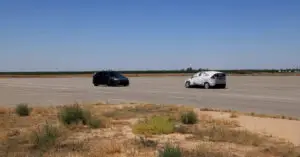
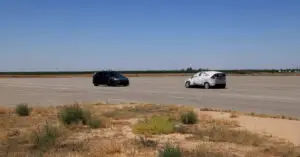
Intersection automatic emergency braking (AEB) handled one tested situation consistently across four 2026 vehicles: each avoided a collision while turning left across oncoming traffic. The results were much less consistent when another vehicle turned into the test car’s path from a side road. Three of the four systems failed to prevent a collision in that scenario, showing how much performance can depend on the direction of the conflict.
The vehicles were a Chevrolet Equinox, Ford Explorer, Hyundai Tucson and Tesla Model Y. Testing took place on a closed course in controlled daytime conditions, with a robotic soft vehicle standing in for the other road user. The test report describes 74 runs across two intersection crash geometries: a vehicle turning into the test car’s path and a test car turning across the path of oncoming traffic.
Different left-turn setups, one side-entry test
The turn-into-path scenario put the test vehicle on a straight course at 30 mph. The soft target approached from a perpendicular road and turned right across its path at 5 mph. This setup tested whether the system could detect a crossing vehicle and respond before impact.
For the left-turn scenarios, the test vehicle crossed the path of an oncoming target traveling at 18.6 mph, while the test vehicle turned at 9.3 mph. The researchers used three variations: a standardized setup with the turn signal on and steering controlled by a robot; a version with the turn signal off; and a version in which a driver steered manually with the signal on.
Those variations matter because an AEB system may respond differently depending on how the vehicle is being driven and what signals it detects. The test results do not establish how every system would perform in every intersection or road condition. They show performance in these specific setups, under controlled conditions.

Manual-steering turn-across-path test runs for each vehicle.

Turn-into-path test runs for each vehicle.
Consistent results have a narrow boundary
All four vehicles avoided the target in every valid run of the standardized left-turn configuration. That aligns with a limited set of intersection tests added to Euro NCAP in 2020, including a left turn across oncoming traffic. The strong result is meaningful, but it applies to a defined test arrangement; it does not show that the systems handle every crossing conflict equally well.
The side-entry results expose that boundary. When a vehicle turned into the test car’s path from a side road, three systems did not prevent a collision. That distinction is practical for drivers: an AEB feature’s name alone won’t tell them which intersection situations it can handle. The direction and timing of another vehicle’s movement can change the challenge the system faces.
Each vehicle was scheduled for five runs per configuration. If a system gave neither a forward collision warning nor braking intervention during the first three attempts in a configuration, testing there stopped to limit the chance of damage. The 74 runs therefore reflect both repeated trials and a safety limit on continuing a poorly performing setup.
Why intersection coverage matters
Vehicle-to-vehicle AEB testing in the United States has historically concentrated on rear-end crashes. Yet an analysis of 2020–2024 crash records cited in the report found that angle crashes—including turn-across-path, turn-into-path and T-bone configurations—accounted for about 41% of reported two-vehicle fatalities. The figure covers a broader group of crash types; it should not be read as a measure of how often these four vehicles’ systems would prevent such crashes.
Earlier testing in 2022 found that vehicles without manufacturer-identified intersection AEB functionality gave no warning or braking response in the intersection scenarios evaluated at that time. The newer tests show progress in a particular left-turn arrangement, alongside a remaining shortfall when traffic enters from the side.
A draft intersection test procedure was developed in 2019 for research, but no final test standard has been implemented. The 2026 results add evidence for broader evaluation across intersection layouts and driving conditions, especially scenarios where another vehicle turns into the test car’s path. Wider testing would help distinguish systems that work in one carefully defined setup from those that respond across a wider range of crossing conflicts.
For drivers, intersection AEB is best treated as an added layer of protection. The test findings don’t support relying on it to manage every conflict. When approaching an intersection, keeping a foot poised above the brake can shorten the time needed to respond; drivers should also watch for vehicles turning across their path and be ready to brake or steer.
Featured image: An AAA test run with a 2026 Tesla Model Y. Photos and videos provided by AAA.