Review: 2028 Volvo’s XC60/90 PHEVs get 80 miles of EV range, changing the game
Volvo flew us out to Copenhagen to drive across the bridge to Sweden to check out the upcoming 2028 XC60 and XC90 plug-in hybrids. The new vehicles promise to double the EV-only range to 73-78 mile...
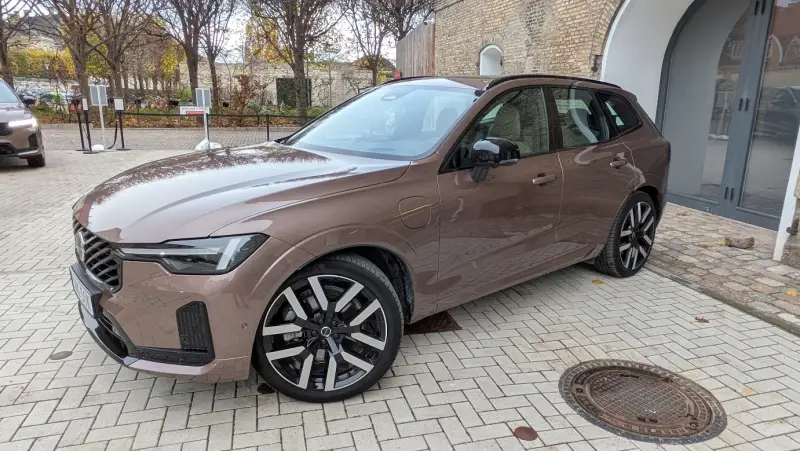
Volvo flew us out to Copenhagen to drive across the bridge to Sweden to check out the upcoming 2028 XC60 and XC90 plug-in hybrids. The new vehicles promise to double the EV-only range to 73-78 miles, making them a new breed of hybrid rarely seen outside China. But what can you do with so much EV-only range?
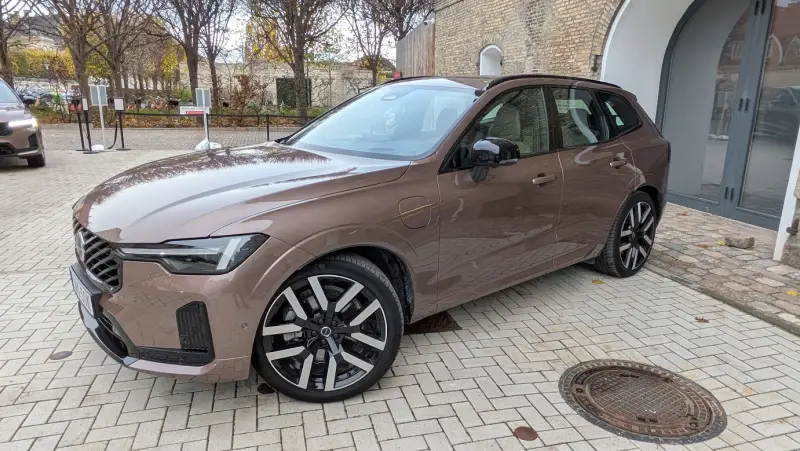
At Electrek, we’re usually pretty skeptical of plug-in hybrids. Too many are glorified gas cars with 20-mile batteries that owners often don’t bother to charge. The electric-only powertrain is often underpowered and not something you can actually use day-to-day.
Volvo’s upcoming 2028 XC60 T8 and XC90 T8 “Long-Range” PHEVs are the rare exception that actually force us to pay attention. By stuffing a 41.2 kWh floor-mounted battery (37.9 kWh usable) into its solid but aging SPA1 platform, Volvo has more than doubled the electric range of its two bestselling SUVs. Both now have more battery capacity and range than the original all-electric Nissan Leaf, Hyundai Ioniq, and many of the compliance EVs that followed. Volvo also doubled the charging speed from 3.6kW to a more reasonable 7.2 kW, meaning charge times are roughly unchanged.
The Powertrain: Finally enough battery to matter
Both the XC60 and XC90 share the exact same T8 AWD hardware: a 247-hp 2.0-liter turbocharged four-cylinder up front with a 70-hp front e-boost motor, and an upgraded 174-hp electric motor on the rear axle. Combined output lands at a healthy 455 horsepower and 560 lb-ft of torque.
The real headline, though, is the electric range:
- 2028 XC60 T8: Up to 78 miles of preliminary EPA-estimated EV range (590 miles combined) and 67 MPGe.
- 2028 XC90 T8: Up to 73 miles of preliminary EPA-estimated EV range and 61 MPGe.
Those numbers easily crown both Volvos as the longest-range plug-in hybrids coming to the U.S. market, blowing past the Mercedes-Benz GLE 450e, Toyota RAV4 Prime, and Range Rover PHEVs, which top out around 50 miles. With the average American commuting around 30 to 40 miles a day, you can genuinely treat either of these SUVs like a full EV Monday through Friday without waking up the gas engine once…or so it would appear on paper.
Sadly, there are some caveats to consider that will make these a little harder to run EV-only. First, to accelerate quickly off the line or to operate in AWD mode, the gas engine needs to engage. That makes winter driving and spirited driving a gas-usage endeavor. Also, without DC fast charging, the Level 2 charger tops out at 7.2 kW, meaning longer trips will also require gas usage.
On the plus side, even with the cold weather and snow tires, I saw range over 145 kilometers/90 miles on the XC60 when fully charged.
2028 Volvo XC60 T8: The sharper, fresher pick
If you don’t need a third row, the XC60 is easily the more compelling package.
At 4,855 lbs, it’s quick—ripping from 0–60 mph in 4.5 seconds—and surprisingly efficient for a bulky crossover, sipping 48 kWh per 100 miles in electric mode and returning 29 mpg combined once the battery is depleted. Unlike the XC90, the 2028 XC60 also gets a proper visual refresh, complete with a cleaner front fascia, Matrix LED headlights, horizontal taillights, and an updated interior featuring Google Gemini on its not huge but very usable 11.2-inch touchscreen.
It’s also the easier daily driver in tight spaces, with a 37.4-foot turning circle and slightly more first- and second-row legroom than its bigger sibling. The trade-off is utility: you’re limited to 21.1 cu. ft. of cargo space behind the second row and a 3,500-lb towing capacity.
2028 Volvo XC90 T8: The three-row bridge to full EVs
The XC90 is the family hauler for buyers who want a three-row electric SUV but aren’t quite ready to jump into an EX90 or Rivian R1S.
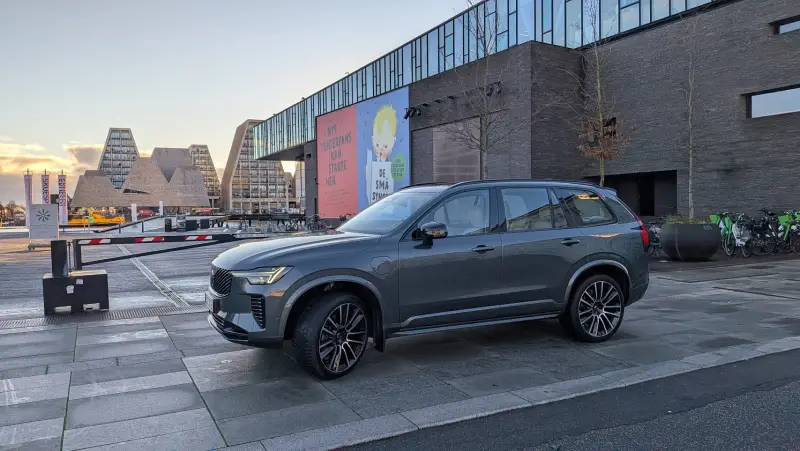
Because Volvo redesigned the battery into a flat, floor-mounted pack, you don’t lose the XC90’s practicality. You still get 6- or 7-passenger seating, 34.5 cu. ft. of cargo room behind the second row (up to 69.4 cu. ft. max), and a serious 5,000-lb towing rating. Even with the extra bulk, it hits 60 mph in 4.9 seconds.
The downside? Efficiency drops to 53 kWh per 100 miles (27 mpg on gas), the third row’s 31.9 inches of legroom is still best reserved for kids, and outside of the new battery and Google Gemini integration, the cabin and exterior are essentially carryovers, which isn’t necessarily a bad thing since we love Volvo interiors.
The big EV caveats:
Even with a 41.2 kWh pack, you can’t completely hide the compromises of a plug-in hybrid:
- No fast charging in sight: Refilling that 37.9 kWh usable pack takes 5.7 hours on a standard U.S. Level 2 home charger—and a painful 27 to 53 hours on a regular 120V wall outlet. I don’t hate this because on trips and other times that you need quick range, you’ll just jump into gas mode, but it would be nice to have DC fast charging
- RWD-only in EV mode: Because the gas engine (plus an EV helper motor that can’t operate on its own) powers the front wheels and the main electric motor drives the rear, running in pure EV mode means you’re driving a rear-wheel-drive SUV. In winter weather, demanding all-wheel-drive traction forces the gas engine to kick on. So does gunning it at a green light and the motor stays on for a bit.
- Double the complexity: You’re still maintaining an 18-gallon fuel tank, a turbocharged four-cylinder, and an 8-speed automatic transmission alongside a full EV battery pack. More to haul around, more space taken up and more to go wrong.
- Not a direct EV issue but the Volvo SP1 doesn’t do wireless Carplay/Android Auto natively. You’ll need to plug into USB-C or buy a third party dongle to connect wirelessly. The upside is that Google’s Android in Volvo center stack has most of the same apps as your phone and a fast, native display vs the lag sometimes felt in projection systems.
Electrek’s Take
Look, we’d still rather see buyers go all-electric with the upcoming EX60 or EX90, and if Volvo prices these 2028 T8s too close to $70,000–$80,000 when deliveries start in early 2027, going full BEV will still be a no-brainer in my book.
But for those who aren’t ready to make the leap to full EV, these vehicles are incredibly compelling. Every morning, assuming you’re on a Level 2 charger, you have almost 80 miles of EV range, about double the average American daily usage. Then, of course, the backup of the 18-gallon tank and gas motor for those edge cases like trips or towing in cold weather are covered.
So the takeaway: if you’re going to build a plug-in hybrid in 2027, this is how you do it. Giving drivers 73 to 78 miles of real electric range turns the gas engine from a daily necessity into a road-trip range extender. For households with a Level 2 home charger that still have lingering charging anxiety on long highway trips, the 2028 XC60 and XC90 T8 are easily the smartest PHEVs on the market. Not to mention the smooth, quick and safe rides Volvo is known for.
FTC: We use income earning auto affiliate links. More.