Drivers divided on how F1's 2030 overtaking aid should work
The Las Vegas GP put overtaking in F1 into a fresh spotlight, but the drivers aren't aligned on how the 2030 V8 overtaking aid should be defined
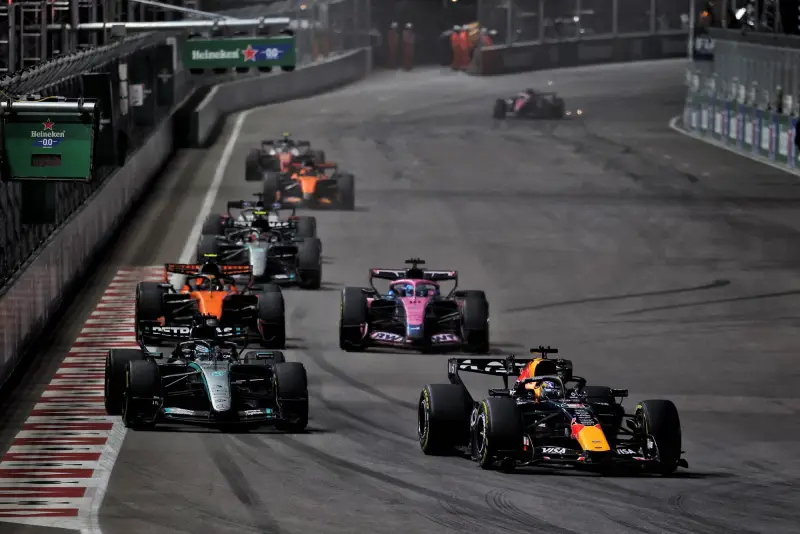
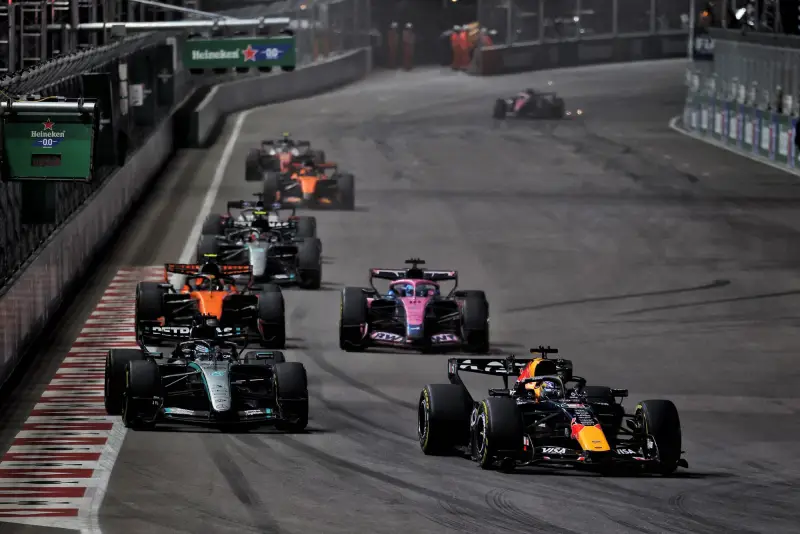
The Las Vegas Grand Prix spectacle might not have silenced critics over the artificial elements of Formula 1’s current rules, but there was one element to it that even staunch critic Max Verstappen thinks should be carried forward to the new 2030 cars.
Despite his perfectly judged execution in Las Vegas that helped pull off a memorable triumph, Verstappen was not impressed with how things played out in a race he likened to Mario Kart.
Yet there was one underlying aspect to Las Vegas that contributed a lot to its 352 passes, and is something that Verstappen suggests should be pondered as F1 begins pulling together its vision for 2030.
It is that the Las Vegas show was not just about battery offsets, which were the trigger for the early season yo-yo battles that we saw in Australia and China for example.
The dynamics of the Las Vegas race, with the leader unable to break away and a pack of cars compressed in a train behind, were set up by the slipstream being so powerful.
Even if a car fell outside the magic one-second window where they would lose overtake mode, they would regain that and more long the Las Vegas Strip simply through a super powerful tow.
This had been helped by cars running out of battery energy at the end of the long straight - so the power to drag ratio shifted dramatically.
Racing Bulls driver Arvid Lindblad said: "It actually worked well for racing. You did half the lap with 500 horsepower, but with the drag of an F1. So then it's like putting an F3 engine in an F1 car. You want as big a tow as you can find because it's super draggy, but you have no power."
Alpine's Pierre Gasly added: "From P2 to last, it was a certain race in terms of you had to be smart in the way you manage your energy, in the way you make the moves, in the way that you drive and stay in that gap to benefit from the tow.
"For the leader, regardless of your speed and how well you drove, Max [Verstappen] or George [Russell] were losing so much time from punching in the air and being at the front end of that pack that there was just no way [to pull clear]."
It was this super powerful tow phenomenon that Verstappen thinks should be central to the concept of the new generation cars in 2030 – as it would help improve the racing and reduce the need for things like DRS.
Asked by The Race about his vision of what would make the purest car for racing from 2030, Verstappen said a combination car concept and simpler engines would be perfect.
"With all the things that we have developed in the past, if you see from like the 1980s to 2010, of course you had dominant cars, dominant teams," Verstappen said.
"They were sometimes over a second or two seconds a lot faster. Now I don't think you will have that anymore. But you can still come up with a formula where maybe a car is just super draggy in a straight line, so you don't need to rely so much on DRS.
"A push-to-pass system for me is fine. But yeah, it needs to be a much easier engine. Like every time I do a show run, for example in an RB7 or whatever, it's just so nice to drive because the throttle response, like everything, is just easy.
"It drives off nice, the car is not shaking about, it has no lag, stuff like that. It's just a lot nicer to drive than what we have currently.
"So as long as we can get back to an engine close to that - I know it needs to be some kind of hybrid element, probably even a turbocharger because otherwise you're probably not even allowed to drive at some tracks anymore because it's too loud, which is fine.
"As long as it's not overruling the natural driving element, which of course at the moment it's happening."
The art of overtaking
The often counterintuitive driving requirements of the 2026 cars are something that continues to annoy many in the pitlane, but there is equal disdain about how the nature of overtaking has changed.
One of the big decisions that needs to be made for 2030 is what type of extra overtaking aid will be used to accompany the new turbo V8s.
Options on the table include keeping the current overtake mode concept, a push-to-pass system like IndyCar has, or going back to DRS.
While DRS also had its critics at times for being artificial, Aston Martin’s Lance Stroll is one who thinks it delivered a more natural form of racing than what happens right now.
"I think the DRS races are better than we have now," he said. "Were they perfect? No, in an ideal world, you'd want to kind of be able to follow a car with absolutely no disturbance and then not have to rely on DRS or anything like that."
Stroll acknowledges that DRS had its flaws in terms of being too powerful at times, or often not working well enough, but he felt that one of its strengths was how it opened up overtaking opportunities.
"Where the DRS was thought out well, and where the straights were reasonable and then there's a good overtaking zone, we always saw really good races with DRS," he said. "But there's some tracks you just can't overtake at all. So that doesn't work either. I think it's tricky.
"It's tricky to get all the stars aligned. But what we have now is definitely not the way forward because you're not overtaking into a braking zone. You're overtaking halfway down the straight and that's not exciting.
"With DRS, it wasn't perfect, far from it. But you want to just see the car getting close enough where you can make a move going into the corner and not just overtake down the straight because you are 50km/h quicker."
This art of the overtake – about it being a move a driver has to make rather than something that happens without effort – is something Carlos Sainz thinks is essential.
"I think the delta on speed should come more at the beginning of the straight when you are trying to keep the slipstream rather than at the end of the straight when the overtaking and the speed is too high," he said.
"I think the power of the overtake mode, push to pass, DRS, whatever you want to call it, should happen exiting the corner. That you have an extra power boost, let's say, to catch up what you're losing in the corner, but the boost shouldn't then help you to finish the overtake.
"I think the boost should help you manage to get back into the very close slipstream and then use the draft and the rest of the braking point to make your own move.
"That is my ideal way of how a push to pass, KERS, deployment, call it whatever you want, should work.
"I think the weird overtaking that happened also a bit with DRS is when you get delta top speeds of 30km/h and you arrive so quick that even when you're in front, you're too scared to defend and cut him off because the delta speed [speed difference] is so high."